Two Riders Were Approaching
The account which follows is drawn from the Collective's notes for the days spent at Bakara village and on the road back to Bombay.
It was His Lordship's intention to wait at least two days in Bakara village, despite it being riven by cholera, to protect the injured Tomlinson and in the hope that relief would arrive from Bombay. Still plagued by disturbing dreams and surrounded by the dying, the smell of the funeral fires in his nostrils, time hung heavy on Arbuthnott. The Professor, meanwhile, found some solace in the wisdom of the East, meditating and philosophising with the Sadhu who kept vigil in the middle of the village. Tomlinson did nothing but rest, trying to build his strength for the journey onward, wherever that would be. On that matter there was some debate — should an immediate return to Leighton's bungalow be pertinent? Should the party travel straight to the North? Or return to the bustling majesty of Bombay?
The latter was decided on — if there was relief, they would meet it on the road. If there was danger, they would face it. The Sepoys must be returned. A report must be made. Samson and Spencer must be attended to. The party would spend one more night, then leave on the morrow.
The sound of horse-hooves was heard, the initial thought was relief had arrived. But the riders were coming from the East. Two horsemen.
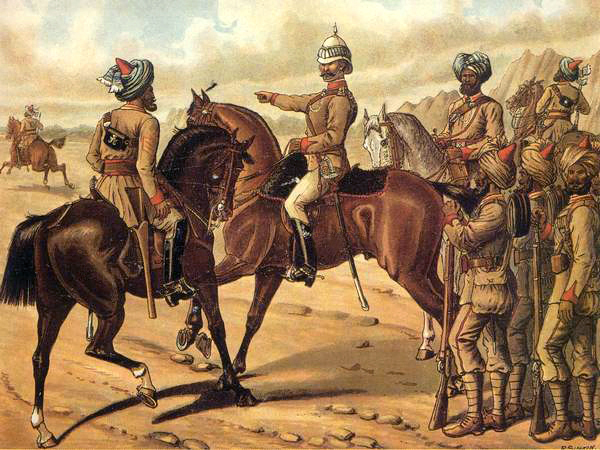
Arbuthnott marshalled the Sepoys to attend him and meet the riders on the bridge. They could see the lead rider was a Sahib, his companion a native. His Lordship relaxed somewhat, as he recognised the Sahib from the Bombay Club, and hastily relayed the events of the past few days. The Professor, who had been lurking off the track, then approached and enquired of the Major his Christian name. Archie, curious too, had also approached. Once it became clear that this was Major Eldred Reece-Jones, suspicions were immediately aroused. Was this the mysterious E.R.J. of the revolting notebook found in the Tykhana? What was he doing out here, coming from the East? The very direction that the blinding light came from, 'the radiance of a thousand suns'?
This was all too much of a coincidence for the Professor, who levelled his shotgun and cried traitor; baldly stating that the Major had fraternised with cultists, betrayed the Raj, Queen, country, and so much more besides. A tense stand-off ensued, the Sepoys reluctantly levelling their rifles at 'Prof-Sahib' — what madness had descended upon him?
Despite the political complexities, His Lordship was inclined to agree with the Professor. He had seen too much death and pain to write this off as a British Officer 'gone native', and reinforced the Professor's view. But then some overpowering thought forced itself into his mind. This was insane; pointing firearms at a Major-Sahib was treason itself, form must be maintained, honour must be upheld, the prestige of the Raj and the Sahib-log must not be sullied with this indignity in front of the men and villagers. He ordered the Sepoys to stand down and the Professor to lower his shotgun. The Major said he would ride post-haste to Bombay, and fulfil his promise to ensure fresh horses were brought for the party — if the Professor insisted on satisfaction he would happily give it, but not here and not now. They watched as the Major rode off, followed by his native servant.
Their hand was played, and there was nothing left but to leave the village, and execute their plan for better or worse. One more night would be spent in the village, and tomorrow the party would head to Bombay, led by the village shikari.
It had struck the party that while the villagers who could still stand had come to watch the parley, the hakim had made himself scarce. His Lordship went to look for him and found him in the trees. The hakim warned His Lordship about bringing the wrath of the Raj onto the area — villages would be burned, innocents would be tortured and hanged, suspects blown from guns — 'they do not understand India as well as the Burra-Sahib does.' Whatever feelings these thoughts stirred in the Lieutenant-Colonel he kept to himself.
Seeing that even the Sadhu was feeling the cold hand of the 'blue death' upon him, the Professor felt he should make a gift to the Sadhu, and presented the Sanskrit copy of the Bhagavad-Gita to him. This was a wondrous gift indeed, and the holy man promised that he would remember the 'Prof-Sahib' in his meditations, for many circles of time.
The Professor feared that none of the villagers would survive. There was something strange about this sickness. Something otherworldly. Like a dark wind blown from the brightness of a thousand suns, like Lord Krishna revealing his true form to the startled Arjuna. Something beyond the comprehension of man.
And so to Bombay. Two days' travel through hunting trails that only a native would know, His Lordship plagued by dreams he could not remember, they finally reached the suburbs of the city. Smoke could be seen coming from fires burning in the seat of the Presidency — clearly there was some unrest amongst the teeming multitudes.
Here end the notes for Sunday, November 19th, 1893, with the party arriving back at the outskirts of Bombay.
— The Editor