On the Founding of the Collective
Of the Late Vigilance Committee, and What Came After
The earliest papers in the Collective's archive concern not its founders, but its precursor — the Arbuthnott Vigilance Committee, that ill-starred company convened in the summer of 1893 by John Murdo Arbuthnott, 10th Viscount of Arbuthnott. None of its members survived to tell of its end.
What follows is the Editor's reconstruction.
The Vigilance Committee
His Lordship had taken it upon himself to address a matter the Metropolitan Police could not: the killings then attributed to the figure known to the press as the Limehouse Piper. To that end he gathered five.

John Murdo Arbuthnott, the Committee's founder, was at this date a man of fifty-one — a widower of two years' standing, retired from a controversial career on the Indo-Tibetan frontier and in the Arctic, and resident at the Bloomsbury townhouse where he kept the singular collection of relics, weapons, and effects he was pleased to call his Indian Room. Sandy's elder brother by twelve years.

Lady Edith Burton-Smith, his protégée since girlhood. The daughter of his old comrade Captain Walter Burton-Smith, who had died in India when she was a child, she had grown up in part at the Bloomsbury house, with the library and the Indian Room for her schoolroom. By 1893 she was thirty-one, an explorer and writer in her own right..

Dr Henry Powell, alienist, formerly of Broadmoor, latterly in private practice. Forty-four. He had attended Captain William Leighton — his Lordship's closest friend — after the Captain was shot at his Royal Geographic Society address that September, removing the ball from his shoulder and saving his life, if not his arm.
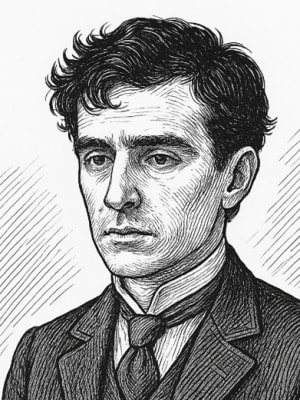
Mr Peter Clare, twenty-six, librarian at the British Museum Reading Room and a poet of unobtrusive gifts. A native of the Shropshire Hills, in whose woods and uplands his work was rooted, he brought to the Committee a particular interest in folklore and the older traditions. He counted among his friends the writer Arthur Conan Doyle.

Sepoy Hamid Din, formerly Captain Leighton's servant, transferred to the Committee while the Captain himself convalesced under guard on the south coast. His Lordship had recovered him, as he had recovered a certain object — a bronze statuette of curious provenance, that the Captain had brought from India — from the Captain's ransacked London residence. The circumstances of that recovery the Editor finds it prudent not to set down at length.
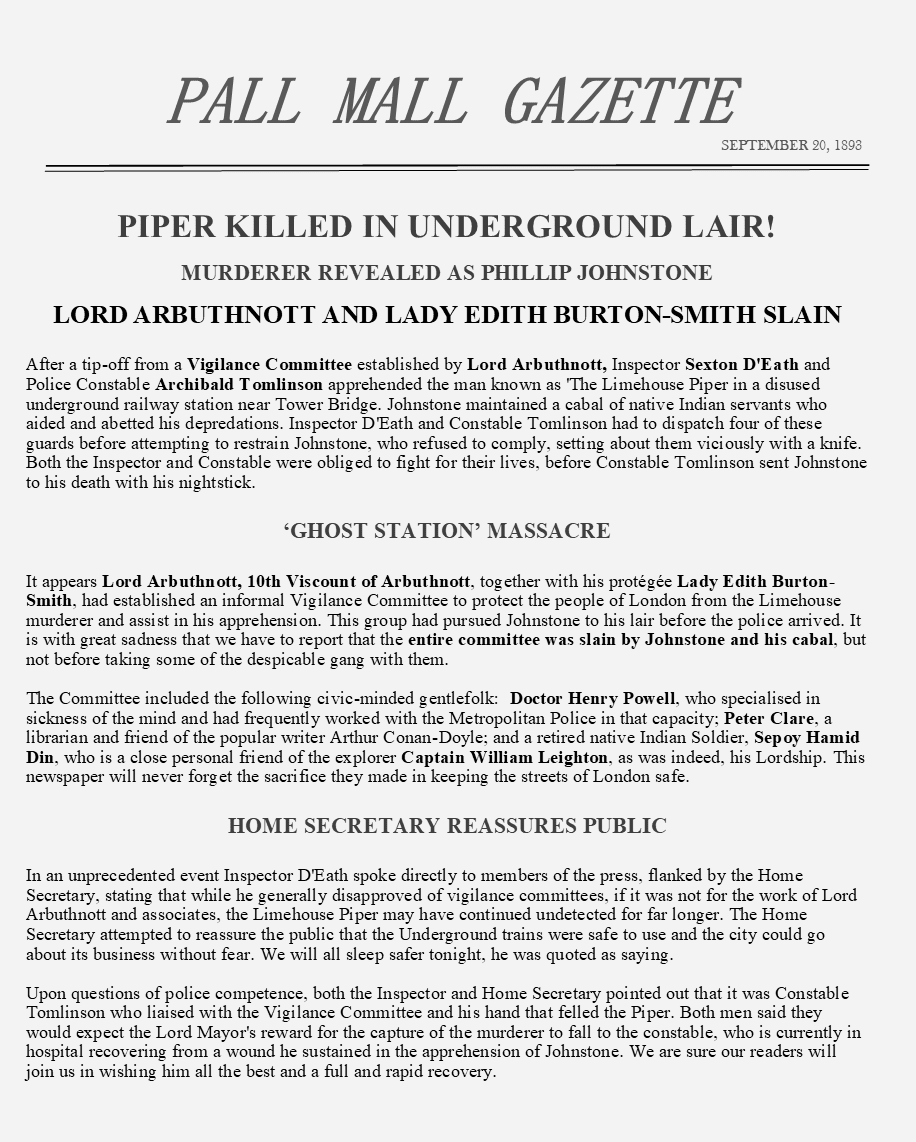
The Committee's pursuit of the Piper culminated, on the night of the 19th of September, 1893, in events at a disused underground railway station near Tower Bridge. None of the five returned. The Piper himself, identified afterwards as Phillip Johnstone, was struck down in the same encounter by Police Constable Archibald Tomlinson of the Bow Division. The bodies of the Committee were recovered the following morning, and identified — those that remained identifiable — by Inspector Sexton D'Eath. The private grief of those who had known them is not the matter of this paper. The public account ran in the Pall Mall Gazette the following day.
The Inheritance

The Editor's narrative resumes with David Arbuthnott — Sandy to his comrades — younger brother to the late John Murdo, and now, by sudden inheritance, the 11th Viscount of Arbuthnott.
The brothers had been close only by correspondence. Murdo had left for India when Sandy was four; the bond between them had been built thereafter on letters and on the hand-drawn maps that Sandy preserved still. Sandy had taken his own commission, in the 19th Royal Hussars; served in Egypt and the Sudan; fought at Tel-el-Kebir and Abu Klea; and risen to Lieutenant-Colonel before declining further promotion to remain with his men. By 1893 he was a senior lecturer at the Royal Military Academy, dividing his time between High Wycombe and Hampstead.
He returned to London within the week. The Bloomsbury house, when he came to it, was much as his brother had left it — the Indian Room still locked, the correspondence on the desk still in its working order, the household still moving about its business under Spencer's quiet hand. He took possession of what had been his brother's, and on the twenty-seventh of September attended the memorial held in London for the fallen. Captain Leighton, lately discharged from the military hospital on the south coast and bearing the empty sleeve that was Dr Powell's last gift to him, rose to deliver the eulogy. A fragment of it survives among the recovered papers:
Murdo died amongst his most trusted friends, defending the innocent. I would of course like to pay my respects to all of his associates who died with him in that hell-hole, but particularly Doctor Powell, who helped remove the ball from my shoulder, saving my life if not my arm, refusing to leave my side throughout the night. And of course, to my loyal friend Hamid, I have already made my peace. It is no surprise to me that he spent his last days serving Murdo and Lady Edith. He knew a pukka sahib when he saw one.
What was said in private between Sandy Arbuthnott and Captain Leighton is not recorded. What is recorded is that, before the close of September, the new Lord Arbuthnott had taken leave of absence from the Academy and had begun to convene a company of his own.
The New Collective
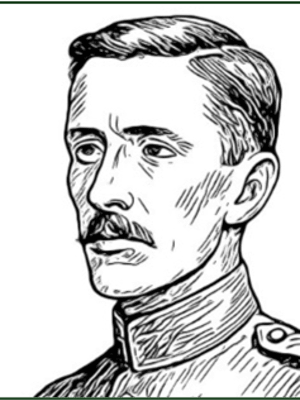
Captain Leighton, late of the Secret and Political Department of the Indian Government and lately honoured by the Royal Geographical Society for his Pamir expedition. A protégé of Murdo from his earlier years in India; twenty-eight years of age; dashing, modest, and trusted in quarters that did not lightly bestow their trust. He had returned from his convalescence on the south coast for the memorial, bearing the empty sleeve that was Dr Powell's last gift to him.
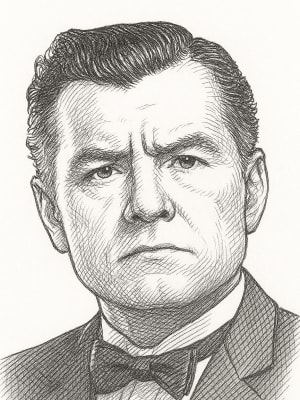
Spencer, butler to John Murdo since 1878. He had served his late master through the Indian years, the Arctic expedition, and the long widowing that followed. He had not been at the Ghost Station; his master had not seen fit to bring him. He declined to be left behind a second time
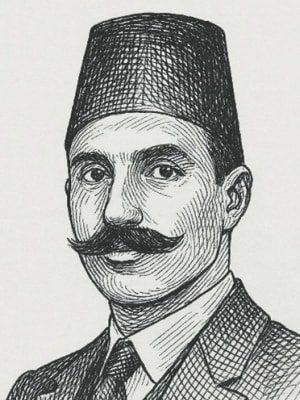
Amin Abanoub el Kebir, twenty-nine, Sandy's man-servant — a Coptic Christian of Alexandria, formerly his batman in Egypt and in his service ever since. He carried at his belt an ancient ceremonial knife of his Church and at his neck a golden ankh given him by his mother, from whom he had been parted in the riots of 1882.

Sergeant Archibald Tomlinson, lately promoted by the Lord Mayor's commendation and lately discharged from St Bartholomew's. His connection to the Committee had not been only professional: he had undertaken, in his off-duty hours, certain private engagements for Lady Edith. He was the chief surviving witness of her death.
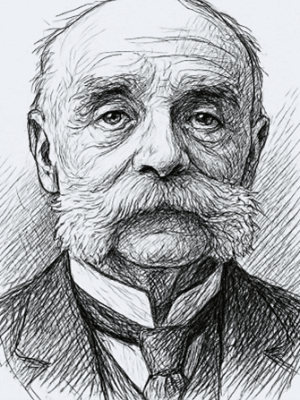
Professor C. Caractacus Clarke, sixty-seven, classicist and antiquarian, outwardly an unremarkable member of the Church of England, less publicly a member of the Hermetic Order of the Golden Dawn. His recruitment was at Sandy's particular initiative, prompted by certain among his late brother's papers which had passed beyond the new Lord Arbuthnott's competence to interpret. The Professor, upon being shown what was shown to him, agreed to attend at Bloomsbury, and, having attended, did not depart.
The papers that follow record the work upon which they embarked, and what came of it.
— The Editor